Is Your Search Strategy Ready for What’s Next? A Look Into The Future of Search with Dominic Cleall
December 10, 2025
Back in October, I had the privilege of traveling from the UK to the US to speak at the Digital Marketing World Forum in New York City, sharing the stage with industry thought leaders to discuss the future of marketing.
At the conference, my talk focused on how brands can ready themselves for what is next in today’s highly fragmented search world.
The discussion that followed my session was one of the highlights of the event for me, underscoring just how important this topic is for marketers today, given the strong interest and thoughtful questions from attendees.
I wanted to recap some of the core themes and insights from my presentation for those who couldn’t join in person.
The Search Crisis: Why Traditional SEO and SEM Are Breaking
Brands today are facing a major challenge as the traditional rules of search are being upended by two powerful forces: evolving consumer search behaviour and the rise of generative AI. Making traditional SEO and SEM more expensive and less effective.
The modern consumer doesn’t search – they discover. For years, the path to purchase was a predictable journey:
- A user had a need
- Typed a query into Google
- Clicked a link
- Landed on a website.
That era is definitely over!
We are in a new era of discovery, one fragmented by social media, driven by conversational AI, and defined by a new generation of users (Gen Z).
The Fractured Landscape: Search is Everywhere
The old destination, the search bar, is now one of many starting points.
Gen Z has shifted search behaviour, transforming platforms like TikTok, YouTube, and Instagram into visual, socially-validated search engines for everything from “nice restaurants in London” to “skincare for oily skin.”
Zero-click search with Google AI overviews is now becoming an essential part of how we find frictionless answers – making traditional SEO brand visibility and ROI difficult to quantify.
AI is also becoming a beacon for multi-dimensional search, enabling users to merge text, imagery, and voice into a single search term, driving further personalized recommendations.
For brands, this means your visibility strategy must extend far beyond Google.
In short: If you’re NOT in the answer, you’re NOT in the funnel.
The Solution: One Integrated ‘Whole Search’ Strategy
Brands need a unified approach that anchors their content strategy in human intent that can be activated across all channels. We call this Whole Search.
“Chasing algorithms is a losing game. Algorithms are constantly changing, but human behaviour signals are your constant.”
Whole Search is a modern, comprehensive approach designed to address the fractured search landscape and rebalance marketing efforts across Paid, Earned, Owned, and Shared tactics.
Whole Search has three essential principles that brands can adopt, to ensure they are creating the content strategy of the future:
Principle 1: Lead with User Intent
The core of Whole Search is understanding the ‘why’ behind the search. Stop optimizing solely for keywords; start optimizing for intent.
Whole Search goes beyond the standard intent categorization (Informational Intent, Transactional Intent, Navigational Intent, etc.).
We add additional intelligence layers, for example, by classifying audience questions across all platforms, from forums and social media listening to traditional search queries we can uncover high-intent questions and build content that genuinely solves problems across the entire funnel and channel ecosystem.
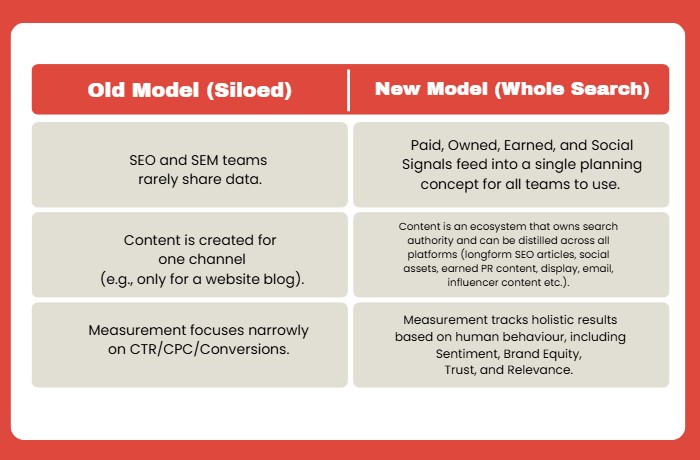
Principle 2: Break the Silos
A cohesive search strategy requires operational alignment.
Teams must Plan, Activate, and Measure together, using one accessible set of holistic insights.
Principle 3: Develop an AI-Ready Content Engine
The future of search is a conversation, not a list of links.
To succeed, your content needs to be effortlessly digestible by large language models (LLMs).
To become the answer, brands must commit to an always-on content engine (not just a campaign mindset) that is specifically optimized for AI, your content strategy needs to answer these essential questions:
- Assess: Can your team move fast enough to respond to trends and news in real-time?
- Optimize: Is your language and are your assets conversational and easily understood by AI?
- Structure: Is your content formatted with clear signals, like headings, clean lists, and structured data that an AI model can reliably parse, cite, and summarize?
The New Search Mandate
The shift in consumer behaviour is rapid, and the technology is accelerating.
This is no longer a conversation about SEO best practices; it’s about competitive survival.
By the end of this article, you should have four key takeaways to ensure your content strategy is ready for what’s next:
- Search is a Powerful Signal of Consumer Behaviour: Be present where your audience begins their journey
- Break the Silos: Plan, activate, and measure as one unified team.
- Lead with User Intent: Shift from chasing algorithm updates to understanding human needs.
- Become the Answer: Build an authoritative, always-on content strategy for the age of AI.
The brands that will win the next decade will be the ones that stop viewing search as a destination and start embedding themselves into the fabric of the customer’s decision-making behaviour.
Want to know more about how we can help with your specific challenges? Take a 3-minute diagnostic quiz to find out
